
Happy holidays and almost‑New‑Year!
This year, instead of spending my Christmas break in airports, I spent it in my favorite place: the lab with my “big boy” toys. I wanted to put some ideas into practice that feel especially relevant given the pressure our healthcare systems and hospitals are under every winter.
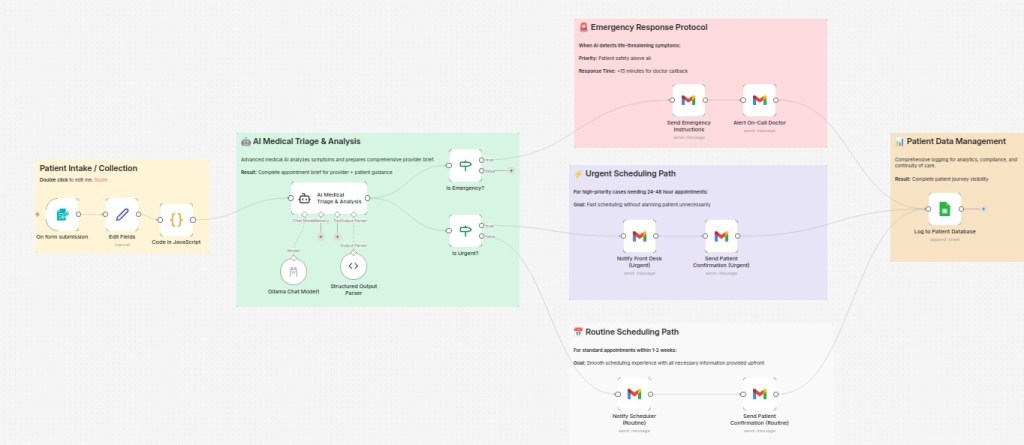
So I built a multi‑agentic & multimodal Patient Triage and i‑Appointment AI system that automates the end‑to‑end patient intake and appointment preparation workflow.
Here’s what it does
📋 Digital Patient Intake
HIPAA‑aligned web form captures comprehensive patient information: symptoms, medical history, medications, allergies, and more.
🤖 AI Medical Triage (Clinical LLM)
– Analyzes symptoms + history, evaluates risk, and generates a 0–100 clinical urgency score with reasoning.
🚨 Emergency Detection
– Automatically flags life‑threatening symptom patterns and triggers an emergency protocol.
🚦 Intelligent Routing based on urgency:
– Emergency (90–100): Slack alert → ER instructions to patient → On‑call doctor alerted within 15 minutes
– Urgent (70–89): Front desk same‑day scheduling → Patient prep email → Provider brief
– Routine (40–69): Scheduler books 1–2 weeks out → Confirmation email → Standard prep
– Non‑Urgent (0–39): Flexible scheduling → Wellness / low‑acuity workflow
📄 Provider Prep Briefs before the visit, including:
– 3–5 differential diagnoses (ordered by likelihood)
– Key questions to ask the patient
– Recommended exams and tests
– Safety alerts (drug interactions, allergies, age‑specific considerations)
– Estimated appointment duration (15/30/45/60 minutes)
📊 Complete Documentation
All data and AI outputs are logged to a secure database to support continuity of care and auditability.
✨ Key Technical/Clinical Features
-Patient AI triage with multi‑Agentic & Multimodal urgency scoring (0–100)
-Red‑flag detection for 20+ emergency patterns (chest pain, dyspnea, stroke signs, severe bleeding, etc.)
– Context‑aware reasoning across symptoms, duration, pain level, comorbidities, medications, and allergies
– Age‑specific assessment (pediatric, geriatric, pregnancy‑aware)
Critical safety checks: drug interactions, allergy alerts, comorbidity risk
– Emergency escalation protocol with clear ER guidance and on‑call notifications
– Pre‑visit preparation for clinicians: questions, exam focus, tests to consider, reference links to clinical guidelines
– Intelligent patient communication: instant confirmation, severity‑appropriate tone, clear instructions on what to bring, how to prepare, when to arrive, and when to call 999 vs. come to clinic vs. wait for the appointment
– 24/7 availability: patients can submit intake forms anytime, anywhere
For me, this is more than a holiday side project – it’s a concrete example of how multi agentic and multimodal AI can orchestrate real clinical workflows:
from intake → triage → routing → prep → documentation.
Curious to hear from clinicians, healthcare IT leaders, and AI folks !
 arshadfarhad.io