
As somebody has said, “Big Data has a little brother. And together, Big and Little Data are far more powerful than Big Data alone”
Most of the past five-ten years’ attention has been focused on “big data,” especially to fuel data science and machine learning. All the energy spent on big data obscured something we used to know: “good things come in small packages”. Small data, however, represents its own revolution in how information is collected, analysed and used.
In healthcare, there is great interest in and excitement about the concept of personalized or precision medicine and advancing this vision via various ‘big data’ efforts. While these methods are necessary, there are evidence that, they are insufficient to achieve the full personalized medicine promise. A rigorous, complementary ‘small data’ model that can function both autonomously from and in collaboration with big data is also needed.
what is Big Data & Small Data?
Small Data: It can be defined as small datasets that are capable of impacting decisions in the present. Small Data is also helpful in making decisions but does not aim to impact the business to a great extent, rather for a short span of Small data can be described as small datasets that can have an influence on current decisions.
In nutshell, data that is simple enough to be used for human understanding in such a volume and structure that makes it accessible, concise, and workable is known as small data.
Big Data: It can be represented as large chunks of structured and unstructured data. The amount of data stored is immense. It is therefore important for analysts to thoroughly dig the whole thing into making it relevant and useful to make proper business decisions.
In short, datasets that are huge and complex that conventional data processing techniques cannot manage them are known as big data.
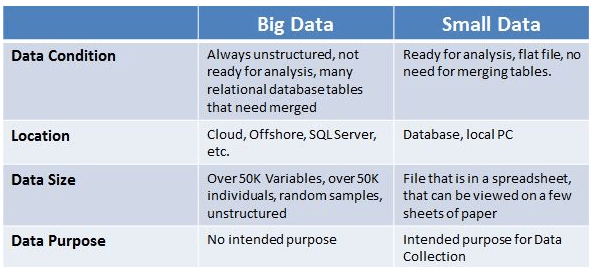
Here is the table help differentiate between the two;
The rise of small data in healthcare: Big data has transformed healthcare in many areas. Analysts extract detailed statistics from a population or an individual to help to reduce costs, carry out new research and identify the early onset of disease.
But recently, we saw a gradual shift in emphasis towards “small data” analytics as hospitals examine their existing data to improve clinical and operational processes and identify cost savings. For many clinicians and front-line healthcare professionals, small data offers the most value to their organizations as it can have a direct impact on patient care. Typical examples of small data include information relating to OT turnover times and missed clinical appointments. Small data provides detailed information on how many times a patient has been admitted to the A&E within the last month, for example.
Small data can also provide insight into significant trends affecting your hospital, especially in the areas of cost reduction.
The Value of Small Data in Healthcare: These individual, real-time snap shots of longitudinal patient experience aren’t being captured by EHRs, and so have largely remained out of the reach of healthcare providers. By leveraging the enterprise cloud and intuitive mobile interfaces, small data can be captured, shared, and acted on in a collaborative fashion by the entire post-acute care team. For example, any of a patient’s providers, regardless of their specific role, can note changes in condition that may signal a worsening clinical state (like an increase in weight of a heart failure patient, or new home hazards that might trigger a fall) and send alerts to the appropriate team member for quick action.
It is these data that occurs at the “Point-of-Living” that has been shown to drive so much of clinical outcomes, for the medically complex elder population who require the largest spend. Activities of daily living, psychosocial issues, caregiver and environmental factors and measurements of a patient’s understanding of her care plan and medications are some of the key dimensions to capture and analyse.
That’s what small data is all about: granular, patient specific information along all dimensions of care that reflect all aspects of health. Health with a capital ‘H’ if you will.
The Four P’s of Small Data : Big data has been defined as encompassing the four V’s: volume, velocity, variety, and veracity of information. We see small data in the healthcare setting as encompassing “four P’s”: punctual, purposeful, prognostic, and at the point-of-living.
- Punctual: small data is timely and transactional in nature. There is very little “lag” in being able to interpret and act on the information. E.g. My patient’s blood pressure is very high today.
- Purposeful: small data represents pertinent information that directly affects patient satisfaction and goals of therapy. E.g. Does my patient understand her plan of care?
- Prognostic: small data can be predictive of impending risk and poor outcomes. E.g. are there hazardous environmental factors in the home that increases risk of falling?
- Point-of-Living: small data occurs everywhere the patient interacts with a multi-disciplinary team, across the care continuum. E.g. My patient’s home health aid noticed she was short of breath when delivering her groceries.
Small + Big= Best of All: Taken together, small and big data sets will create a rich data tapestry across the entire care continuum, and will allow for truly remarkable predictive analytics, cost transparency insights, and comparative product performance analysis.
 arshadfarhad.io