
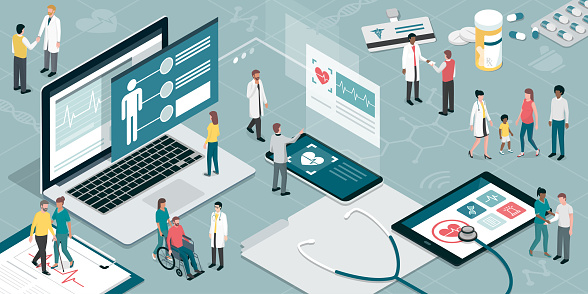
We are living through an experience the vast majority of us have never had before and I’m sure we will remember these times even decades from now. I hope that you and your loved ones are safe. I have had quite a few requests recently asking about the current trends in healthcare and technologies to assist the next phase in current Covid-19 pandemic. So, here are my thoughts based upon personal experience, feedbacks from field and working closely with other key healthcare solution providers.
Let me explain the nomenclature of this blog’s title ‘healthcare IT 1.9 ‘– and why I am not calling it ‘healthcare 2.0 or Healthcare 1.1 or in between’. The reason is simple, based on my personal opinion – the paradigm shift and adoption of different technologies in healthcare and what has been seen so far during different phases in this current pandemic, is hugely significant and I would consider this as a big leap. Perhaps healthcare organizations have travelled 5 years ahead within matter of months but essentially, it’s the pace that has changed, as we have not invented any new concepts. The ideas and solutions have remained the same, such as remote consultation, remote diagnostics, self-service, AI, Big Data and Analytics – we have been talking about these things for years. And hence I am not calling the current wave in healthcare informatics as 2.0 – rather calling out a 1.9 (almost 2.0 but not exactly). I hope that clarifies it. I plan to further write on this 2.0 topic (virtual reality, 3D printing and prosthetics, augmented reality, and even robotic healthcare workers)
in near future – stay tuned!
There is no question about the positive role that technology has played and will continue to play to combat the COVID-19 pandemic. Pandemic in 1918 (Spanish flu) had resulted in 50+ million deaths (https://en.wikipedia.org/wiki/Spanish_flu) whereas this time the deaths are fewer comparatively, although it isn’t over yet. According to WHO, IT and Data have made a huge difference which was lacking in 1918.
It is now accepted that these changes are here to stay. Not only is COVID-19 a pandemic which is unlikely to vanish with the summer but there is a real urgency to develop the insights we need to deploy AI and telemedicine, alongside improving and personalising the care of people who will be affected on the second, third or may be fourth wave. This means that the reliance on medical technological solutions will increase at a pace and scale we have not witnessed before.
The post-COVID world is likely to be remembered as the time when the care of other medical interactions like the provision of primary care or the management of non-communicable diseases shifted to digital modalities as the default rather than the exception. This new post COVID-19 age is also likely to then enable all the other technologies we have been celebrating, like insights associated with AI, and the potential that 5G gives us in terms of the Internet of things to all converge in a whole variety of ways. We are seeing this happen in real-time and at a pace we could never have imagined. In England, primary care at scale has now finally started to embrace telehealth and has deployed a new digital first pathway as a route to managing streaming of care to the appropriate place. This would have been beyond the limits of the possible only a few weeks ago.
The other significant change we can already see accelerating is the adoption of precision health, both in more personalised and predictive public health, but also in utilising digital technology in empowering people to better self-manage in non-communicable disease.
Here are my top 5 digital health technology adoptions in this recent pandemic era.
- Data Analytics – we all have seen and heard a lot about flattening the curve. Data Analytics have helped medical professionals to understand and manage the pandemic better.
- 3D Printing – To meet these demands in medical supplies, the maker community banded together with their 3D-printers. From garage hobbyists to established companies, people are 3D-printing equipment from face shields through swabs to ventilator parts.
- Telemedicine (Remote Healthcare) -Given the virulence and ease of transmission of SARS-CoV-2, social distancing measures are a must. But what to do if you feel sick or are following an ongoing treatment? Should you risk going to the hospital and putting your health at further risk? As for hospitals, they are already overloaded with critical cases; isn’t there a way to reduce unnecessary visits? For these issues, telemedicine is a ready-made option that saw a boom during the pandemic, even after the outbreak subsides.
- Artificial Intelligence (AI) – A.I. is not only being used to track the disease but also to diagnose it. Hospitals in China and in UK are employing software’s to detect signs of COVID-19 pneumonia on CT scans. A new A.I. algorithm developed by the Chinese tech giant Alibaba can detect COVID-19 infections from CT scans of patients’ chests with 96% accuracy in a matter of seconds! As a means to look beyond, A.I. is being deployed to mine the load of research papers surrounding the COVID-19 which have accumulated since the outbreak. While we must be cautious about unrealistic expectations of A.I.’s potential, we cannot ignore its potential in such crisis. As such, instead of fearing a Skynet-controlled future, we should see A. I. as an aide to augment the skills of healthcare professionals.
- Genomics: Gene sequencing: helping in the race to find a vaccine – Gene sequencing of the virus’ genome has been speeding things up to get a viable vaccine out. All of these sequencings and other research and study requires AI and digital capacities. Since the first sequencing was done, nearly two dozen more studies have been completed. All of the combined studies are needed for the crucial development of vaccines. The progression, algorithms, combined global knowledge, and their accuracies can move faster than ever before because of the digital component of the work.
Closing remarks, as you may have noticed that my top 5 picks aren’t anything out of blue; they all have been a topic of discussion for the past 5 years, if not longer and hence my reason not to class current IT shift as a new major release. I believe, from now onwards, there will be a renewed and re-positioned investment made by governments across the globe in their healthcare systems. These progressions are the beginning of a new future. The COVID-19 pandemic, which is probably not going to disappear anytime soon, is also an awakening for healthcare systems. It is time we prepare ourselves with well-equipped AI, Analytics, remote healthcare and other technologies to improve and customise treatments for individual patients. In other words, the dependence on healthcare technological solutions will keep on increasing at a pace and scale we have not seen so far. This has numerous potential outcomes. From diagnosing illness at home to the customised care of patients post discharge from hospitals and giving advice and reminders over video conferencing, change is likely to happen in every sphere of a patient’s journey.
What healthcare will look like in the future is anyone’s guess, but there will undoubtedly be changes because of COVID-19. There will be struggles, and there will be advances, but in the end, whatever ends up being the new normal will significantly impact healthcare organisations and consumers. Stay safe!
 arshadfarhad.io