
Few years ago (four years to be precise), I had the opportunity to watch live robotic surgery at the trust where I was working. I can tell you for a fact that it was the most fascinated thing I had ever experienced.
Artificial Intelligence (AI), Machine Language (ML) or Blockchain in Healthcare – I guess these terms don’t surprise any healthcare IT professional. I have observed that in the last 12 months, more and more healthcare organizations have started to discuss or show interest in exploring potential benefits from their adoption. Blockchain is still new, therefore, I will leave the topic for some other day but today, I intend to share my views on AI and ML in healthcare, at a very high level!
So, what is an AI – there are 100s of definitions but the definition I am going to quote from a Journal is due to its precision and adequacy.
“Artificial Intelligence (AI) aims to mimic human cognitive functions”
There is no denying that AI is dangerously getting closer to doing what humans do (in certain use cases), but in a more efficient, quick and cost effective way. Before AI systems can be deployed in healthcare applications, they need to be ‘trained’ through data that are generated from clinical activities. Hence, we are back to basics, comprising the key element of DATASETS.
In my previous blog I discussed the type of data, i.e. structured vs. unstructured. The datasets for AI can be either or both. For instance, diagnostic use case of AI uses images etc. which are more often unstructured, whereas, decision making capability is highly reliant on structured data.
Before going deeper into it, it is important to know the vehicle for AI. There are quite a few but as of now, I believe the two vital ones are, Machine Language (ML) and Natural Language Processing (NLP). ML uses statistical technique to give healthcare solution the ability to learn, whereas, NLP is the process of using computer algorithms to identify key elements in everyday language and extract meaning from unstructured spoken or written input.
This simple diagram below shows the relationship between the source of data, information, ML, NLP and AI. Some bright colors, I know!!
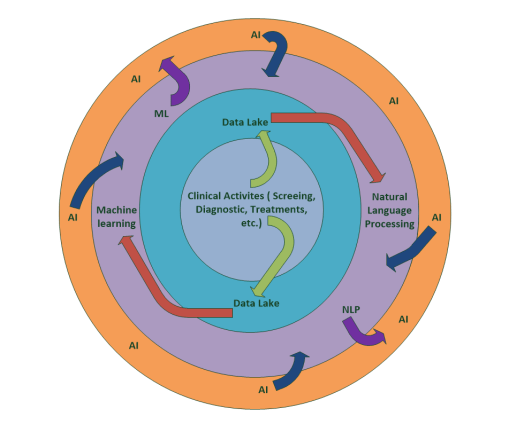
This is basically a continuous cycle, at the heart of which lie all clinical activates that form a Data Lake. Typically, the data sources are EMR/EPR/EHR, hand written notes, digital dictations etc. As a next step, ML and NLP algorithm on data result in the formation of AI tools and application. Finally, the output of AI tools and application is used to improve ML and NLP algorithm i.e. it’s a 360 continuous improvement cycle.
Here are some AI solutions which are being practised in Healthcare.
AI assisted Robotic Surgery – As I stated, I witnessed it and it was unbelievably awesome! Via artificial intelligence, robots can use data from past operations to inform new surgical techniques. The positive results are indeed promising. One study found that AI-assisted robotic procedure resulted in five times fewer complications compared to surgeons operating alone!
Image Analysis – Such as radiology – This has been the most widely utilised solution, currently being used in Healthcare.
Diagnostics – AI is already being used to detect diseases, such as cancer, more accurately and in their early stages.
Research and Training – AI has been effectively employed to streamline drug discovery and drive trainings.
“With great powers, comes great responsibility”.
AI and its vehicles have also got some challenges. The main ones revolve around datasets and data integration. As mentioned before, AI is only effectively operable if it has the necessary datasets. The challenge lies in the process where the AI learns to combine the data and information extracted from various datasets. The other major challenge in today’s digital world is patient privacy and data security. Healthcare practice operates under doctor-patient confidentiality but it gets more challenging in this world driven or integrated with AI.
In conclusion, I would say that a successful AI system must possess the ML component for handling structured data (images, EPR data, and genetic data) and the NLP component for mining unstructured texts. The sophisticated algorithms then need to be trained through healthcare data before the system can assist physicians with disease diagnosis and treatment suggestions.
I would end this with the note that AI and the analysis it provides is invaluable, and it helps physicians to most effectively utilise their time and provide diagnoses. However in my opinion, human care will always remain a crucial part of treatment. No technology can beat that!
 arshadfarhad.io