
What a week! Meetings, workshops and training … Crazy, I tell you!
The thing I love the most about my job is my interaction with customers every day and to learn about the challenges they face, the most feared of them all is – Data Explosion or Growth. Without exaggerating, 95% of all of my discussions start with this topic.
It’s scary for them, but is expected as organizations are adopting ‘paper free’ or similar strategies. The obvious question is DATA MANAGEMENT (throughout its life-cycle) @ THE COST THAT THEY CAN AFFORD!
In healthcare , this is even more interesting because the variants of data sources (people, telemetry, sensors , vital signs, audio, video, genomics, digital pathology, radiology images, patient records, EPR are just a few to name) and their sizes. But one attribute that they all have in common is the ‘access pattern’ – let me try to explain this in clearer terms with the help of this graph below – a good alternative to my usual white board, I must add!
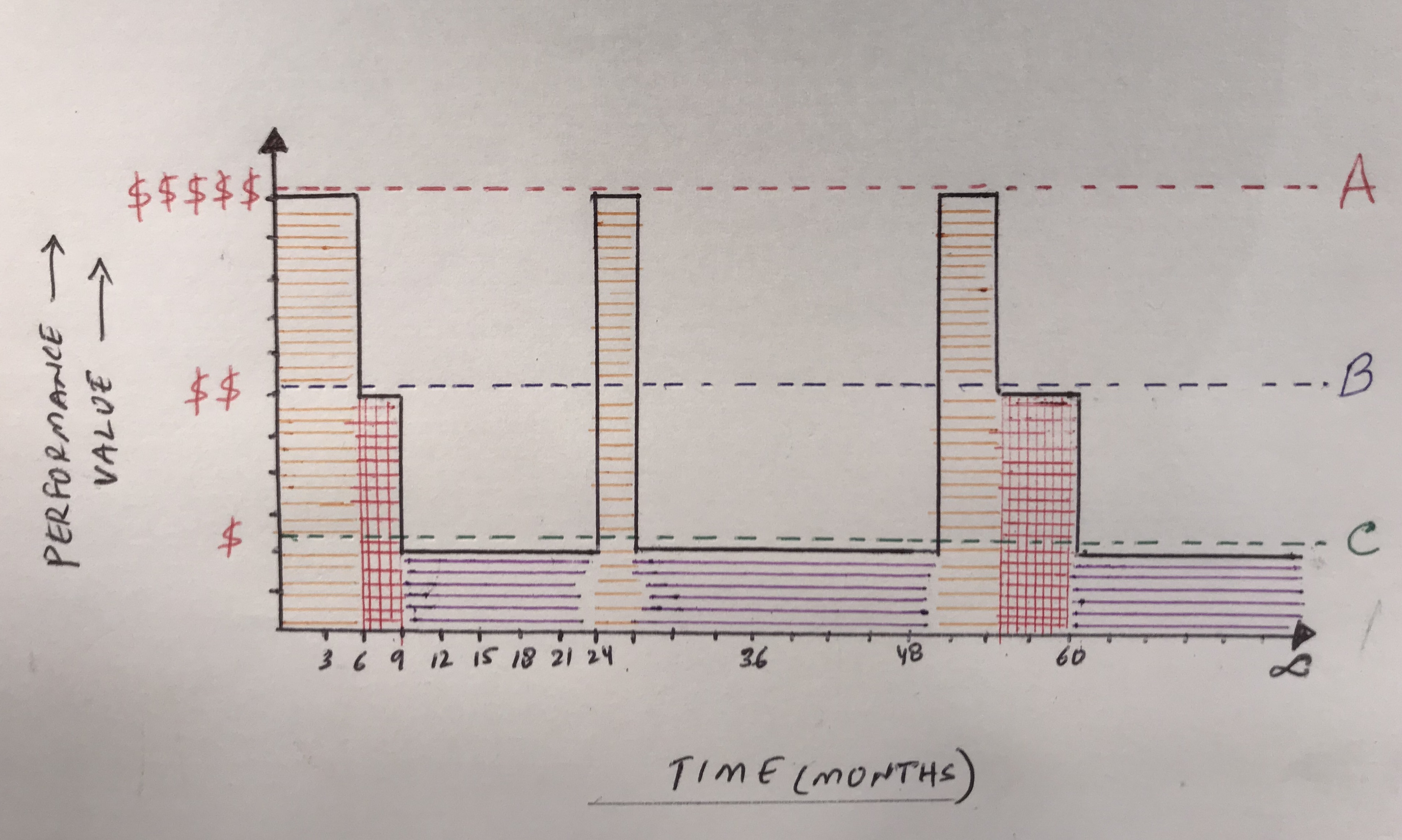
So here is the idiot’s guide to this graph.
A – Shows when Data requires frequent access and performance tier such as SSDs and hence consume a lot of $$$
B – Data at this level stays so it can be recalled back to A – hence it is transient level between A and C
C- This is where data in its entire life sits majority of its life – Archive and hence consume less $
Data, in the first six months gets utilized the most and after 6-9 months, well, I won’t be wrong if I say ‘rarely’ gets accessed. Sometime later down the line, there may be a situation when it is used again but it is not long before it goes again into the ‘stale’ status. Typical examples are PACS, Digital Pathology, genomics data etc.). But the expectation from clinical professionals, and rightly so, is that they can access it when they need (through its native application, original path – with no change in access method)
An ‘FAQs’ before I sign off;
Why would an organization store data in plane A, for its whole life? (Well, one can if budget is infinite)
I can confidently say, from experience as a healthcare IT consultant, that the above applies to around 80-85% of the clinical data that are being generated in healthcare industry.
So here comes the universal fact of data @ the right place, @the right time and @ the right cost. So, to answer the question of data management that the customer usually asks – DATA MANAGEMENT (throughout its life-cycle) @ COST THAT THEY CAN AFFORD! Simple answer – your storage system should have the ability to follow its life-cycle; when it requires access, should be easily and timely accessible and when it is inactive, should not cost you the same $ while in active state. And most importantly, this transfer of data between A, B and C should be transparent to end user and also be automated for Storage admins.
Summarizing above, Storage solutions in healthcare are required to follow its life-cycle i.e. Active, Cold and Archive capabilities. Data movement between these three must be transparent to end users and automated for storage admins. By doing so, over time, the volume of archive tier should only grow which has the lowest $ value attached to it and in most cases, is cheaper to keep in tapes or storing them in films (Radiology), Glass Slides (Pathology) etc. It is very common that retention is not implemented due to its complexities and hence these end up storing indefinitely that results in PBs capacity in archive storage.
Hope this was not too mind numbing!
I personally really enjoy indulging in this – I can only hope you share my enthusiasm!!
Till the next time …..
 arshadfarhad.io